

By Maxine Lowy
Teun de Groot was a bicycle mechanic from Voorschoten, a small town in the western region of the Netherlands. Early one morning in September 1944, the doorbell rang. When he opened the door, two men asked his name and then shot him at point-blank range, killing this father of five. His killers were members of the Waffen brigade, a squad of SS hitmen who specialized in murdering people like De Groot, who had been hiding individuals persecuted by the Nazis in his bicycle workshop.
Several judicial proceedings arising from this and other stories originating in the mid-1940s have reached German courts in the last 15 years for crimes against humanity. Their implications may be relevant for Chilean legislators as they consider Bill 17. 370-17, introduced by five conservative senators and approved by the Chilean Senate on March 5. The proposal would grant inmates over the age of 70 or who have unspecified chronic diseases either house arrest or suspension of their sentences. Among those who could benefit are 365 prisoners convicted of crimes against humanity held at the Til Til Penitentiary Center, better known as Punta Peuco prison.
In 2000, German prosecutor Ulrich Maas, director of the Central Office for the Investigation of National Socialist Crimes, opened a judicial case against Heinrich Boere, accused of the cold-blooded murder of De Groot and two other members of the Dutch resistance. He did so after determining that neither Boeres heart condition nor his advanced age prevented him from standing trial.
In 2010, from a wheelchair, Boere heard the judge of the court in Aachen, Germany, announce a life sentence for the murder of Teun de Groot and other members of the Dutch resistance. The Waffen brigade was responsible for the murders of 54 people, whom they sought out in their homes or workplaces and killed in the same way every time: with a single shot. The court established Boeres direct participation only in the aggravated murders of De Groot and two others.
Outside the courthouse, a group of demonstrators held banners that read in German: No peace for Nazi perpetrators.i
Also present to hear the verdict was De Groots eldest son, who bears the same name as his father. At 77 years old, Teun De Groot Jr. said that his fathers murder devastated the family. I believe that what I hoped for over many years has finally been achieved. ii
Commenting on the ruling, the director of the Simon Wiesenthal Center, an institution dedicated to tracking down Nazi criminals on six continents, said: It is a powerful message that the passage of time does not diminish guilt [] and that age cannot be used as a pretext to evade responsibility.iii
There have been many recent cases. Among them: Oskar Grning in 2015, for complicity in the murder of 300,000 Jews; Reinhold Hanning in 2016, for 170,000 deaths; Josef Schtz in 2022, for the death of 3,518 prisoners at the Sachsenhausen camp; and Irmgard Furchner, also in 2022, known as the secretary of evil from the Stutthof camp. In all these and other cases, the defendants were nonagenariansnone expressed remorseand the sentences they effectively served were limited due to their advanced age. Indeed, in 2013 Heinrich Boere died in a prison hospital at the age of 92.
These trials were made possible by the framework of international law that emerged after the Shoah (Holocaust). First, in 1945, the Nuremberg Tribunal Statutes established the trilogy of war crimes, crimes against peace, and crimes against humanity. Later, in 1948, the Universal Declaration of Human Rights was adopted; in 1949, the Geneva Conventions; and subsequently other treaties. Chile is a signatory to these instruments, as well as to the more recent Rome Statute, ratified in 2009.
Together, these documents establish that crimes against humanityfor example torture, enforced disappearance, sexual violence, or murder carried out by a statewhen committed systematically against a civilian population are so grave that criminal responsibility never expires and they are not subject to amnesties or mitigating circumstances that would result in impunity. This applies both to Nazi war criminals in Europe and to the military and civilians who were part of the DINA and other repressive bodies during the Chilean dictatorship. Justice in these cases represents a moral reparation for society as a whole and is considered necessary to restore a culture of respect and trust among fellow citizens.
Roberto Garretn (19412021), legal director of the Vicara de la Solidaridad and recipient of the National Human Rights Prize in 2020, once told this journalist that the positive legal effects that emerged from the horror of the Shoah are sensational. Garretn commented: What used to happen in Latin America before this culture developed? Coups dtat would end and the dictator would return. No one ever said trial and punishment for the guilty. No one ever said lets create truth and reconciliation commissions. No one spoke of crimes against humanity.iv
In the past, law schools in Chile offered limited international law curriculum, and judges were reluctant to accept arguments based on international treaties. It was the lawyers defending victims of the dictatorship, such as Garretn and many others, who repeatedly grounded their cases in these conventions and, one might say, educated judges about the validity of such arguments.
In 1998, the ruling in the case of Enrique Poblete Crdoba, a metalworker forcibly disappeared in July 1974, was the first in which judges cited international treaties. Later, in January 2004, they relied more heavily on the Geneva Conventions and the Universal Declaration of Human Rights to issue convictions against those responsible for the kidnapping and disappearance in January 1975 of tailor Miguel ngel Sandoval Rodrguez.
In the same year that Heinrich Boere was sentenced in Aachen, Chiles Court of Appeals stripped Augusto Pinochet of his immunity, allowing his prosecution for the aggravated kidnapping of 13 people in the city of Calama in October 1973. The case was known as the Caravan of Death, for the military posse that, under Pinochets orders, from September 30 to October 22, 1973 traversed the country in a Puma helicopter, leaving a trail of 26 people murdered in the south and 71 in the north. Against all predictions, the Supreme Court upheld the lifting of his immunity, enabling Judge Juan Guzmn Tapia to order Pinochets indictment and house arrest.
The dictators defense team never addressed the substance of the charges against their client. Their only defense was to appeal to humanitarian considerations based on his alleged incurable dementia. The argument proved successful two years later when the Criminal Chamber of the Supreme Court dismissed the Caravan of Death case against him- despite psychiatric studies conclusively showing that he was of sound mind. This emblematic case illustrates how humanitarian factors can be manipulated to enshrine impunity.
Pinochets rap sheet and that of the military personnel who answered to him went far beyond the killings in Calama: more than 2,200 people summarily executed, 1,469 kidnapped and disappeared forever, 40,000 tortured, 200,000 forced into exile, and thousands more dismissed from their workplaces and expelled from universities.
The United Nations Human Rights Commission, Amnesty International, the Association of Families of the Disappeared Detainees, and the Association of Families of the Executed Political Prisoners, among other organizations and individuals, have expressed a firm rejection of the bill because of the impunity it promotes and the violation of international law treaties that it represents.
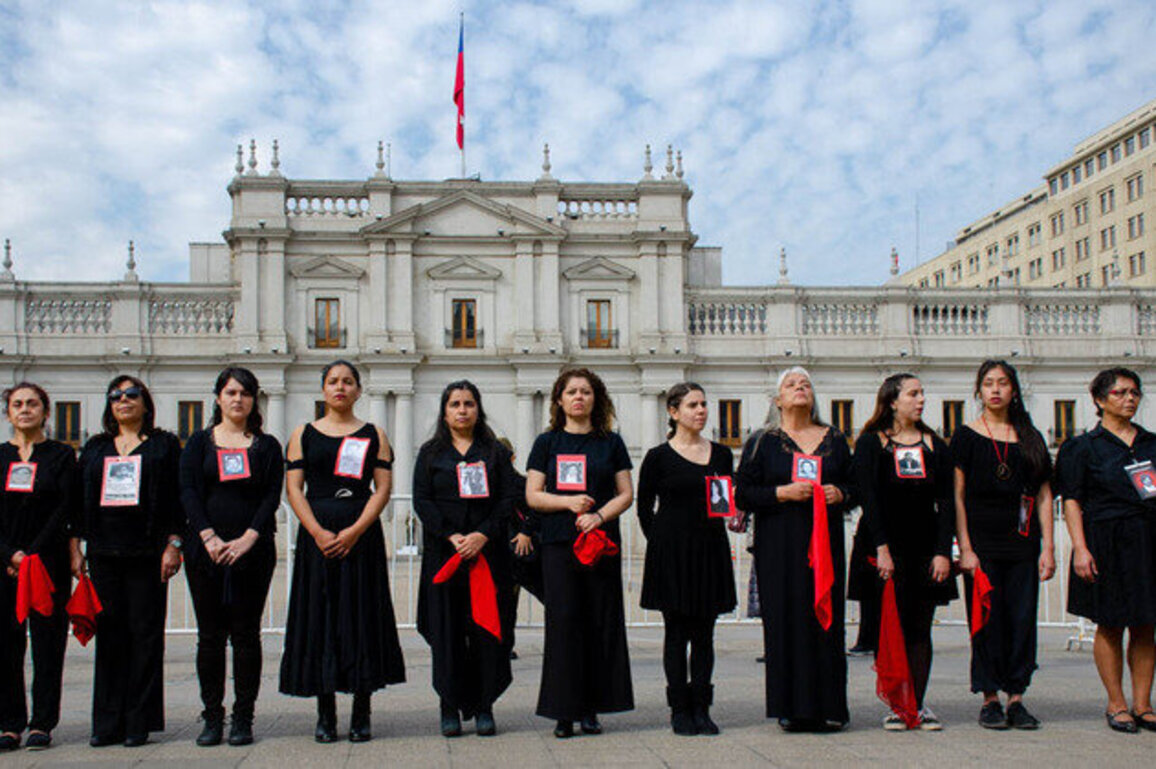
For Ana Mara Carreo, the very idea that these unrepentant criminals might go free makes her shudder.v Like Teun de Groot of the Netherlands, during the cruel dictatorship imposed in Chile, her father Manuel Carreo was a courageous man who sheltered persecuted people in his store in Conchali, a working class neighborhood of northern Santiago. Past midnight on August 13, 1974, repressive agents came to their home and took away her father, of 53 years of age, and her brother Ivan, of 15. Years later, witnesses declared in court that father and son were tortured to death by Miguel Krassnoff, one of the criminals who could walk the streets again, for having recently turned 80, despite multiple convictions for crimes against humanity that sum 650 years in prison. Manuel and teenager Ivan, however, were not permitted to grow old.
Also, like the De Groot family, the Carreo family was absolutely devastated by the loss of Manuel and Ivan. A long, exhausting itinerary knocking on hundreds of doors in midst of ongoing threats finally produced a semblance of justice decades later, Ana Mara Carreo insists, It would be an aberration to award these men for what they did- for our never-ending state of mourning.
i AP Archive https://www.youtube.com/watch?v=nHTlbzpXZgY)
ii Ibid.
iii NBC News: https://www.nbcnews.com/id/wbna23525623)
iv Maxine Lowy, Educating judges on international law (interview with Roberto Garreton), 2004.
v Conversacin con Ana Mara Carreo, 15 marzo 2026.
Redaccin Chile