

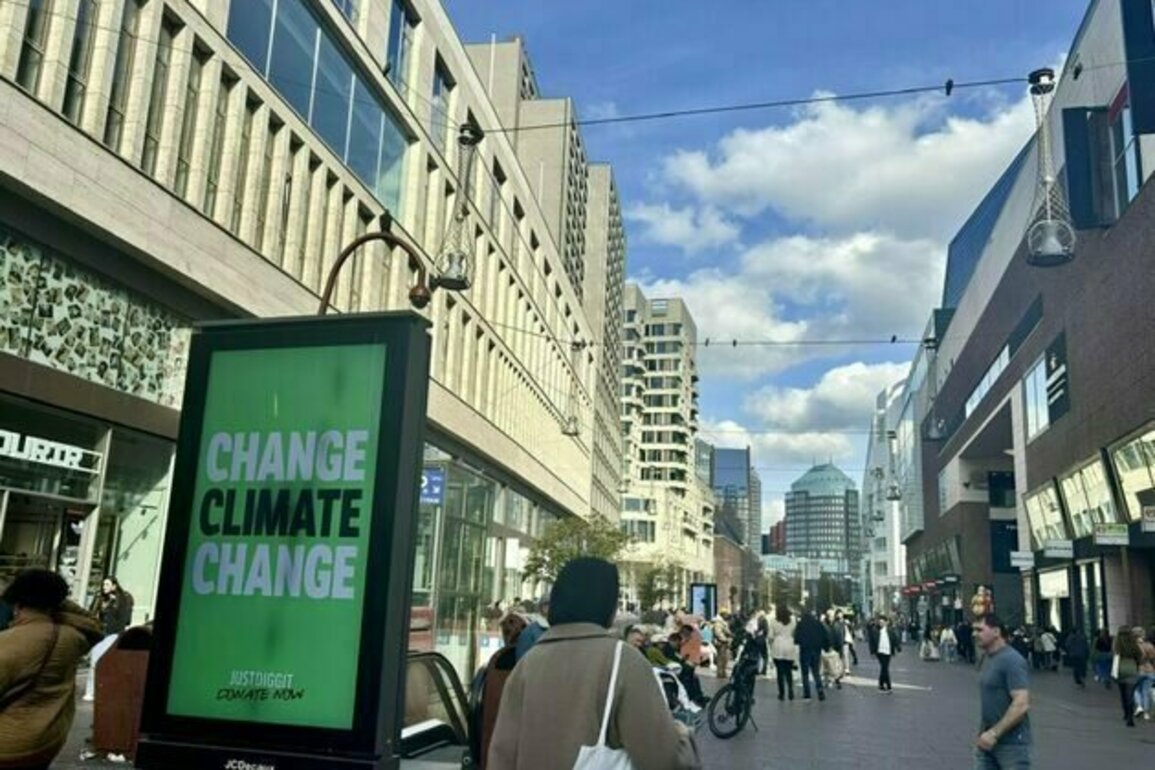
THE HAGUE, Netherlands (CN) - Previously, on any given day in The Hague, commuters waiting for the tram might have glanced up at posters promoting cheap flights, luxury cruises and new cars.
Like in many cities, advertisements linked to fossil fuel consumption were stitched into the rhythms of life here. And so when city council voted last year to ban such ads in public spaces, few believed the measure would survive legal challenges.
Adopted by the city council in September 2024 with an effective date in January, The Hague's ordinance was the first of its kind anywhere in the world.
It was strict, outlawing not just direct advertisements for fossil fuels but also ads for products that rely on them, including flights, cruises, combustion- and hybrid-engine cars and certain utility services, such as electricity contracts based on coal or gas.
The measure was introduced by Robert Barker, The Hague's deputy mayor for public space, animal welfare and the environment and a member of the Dutch environmentalist Party for the Animals.
In a city statement last year, he stressed that "we are in a climate crisis." He argued such advertising "normalizes behavior we need to discourage, like frequent flying or reliance on fossil fuels."
"Allowing fossil fuel ads while at the same time trying to reduce CO emissions is counterproductive," Barker stated. "This ban is a step in the right direction."
The tourism industry hasn't taken the ban quietly.
Travel-agent trade group ANVR sued, arguing the ban crossed a line by limiting free expression and putting their businesses at risk. They were joined by TUI, a German travel and tourism giant.
In court, The Hague said the ban was about protecting public health and fighting climate change.
The city said that letting fossil fuel ads take over public spaces only made harmful habits feel normal. It argued its rules were reasonable since companies could still advertise on TV, radio or online.
Judge S.J. Hoekstra-van Vliet agreed. When the case landed in the city's district court in April, she tossed it, ruling that public health and the climate outweighed the commercial freedoms of airlines and energy companies.
In her ruling, Hoekstra-van Vliet said cities have not only the right but the duty to protect public health and the environment. Siding with The Hague, she said pulling certain ads was a fair step when faced with the dangers of climate change.
The decision leaned hard on European precedent. In June 2024, before the Hague adopted its ban, UN Secretary-General Antonio Guterres stood before a packed hall in New York and urged governments everywhere to ban fossil fuel advertising.
Blasting oil and gas giants as the "godfathers of climate chaos," he said: "We need an exit ramp off the highway to climate hell." He also called on advertising and public-relations firms to stop providing services to the industry.
For campaigners, the ruling marked a real breakthrough. ClientEarth, a London-based environmental law group that helped campaign for the ban, hailed the judgment as "a bold step in the right direction."
In a statement afterward, ClientEarth lawyer Jonathan White drew a parallel. Just as banning cigarette ads was once a public health milestone, he said, restricting ads for fossil fuels could also help curb their use.
The ban was pushed by Reclame Fossielvrij, a Dutch campaign group whose name literally translates to "Fossil-Free Advertising."
In a statement to Courthouse News, the group struck a similar note.
"Everywhere - whether local, regional or national - governments have a duty to protect their citizens from dangerous climate change," a spokesperson wrote. They added that corporate speech had to sometimes be limited when it drove harmful behavior and that shifting social norms were just as important as new policies or technology.
Naturally, industry groups saw the ruling differently. In a statement to Courthouse News, Dutch advertisers' association BvA warned that "categorical advertising bans do not align with the fundamental principles of commercial communication and freedom of expression."
The group stressed that advertising is not only a form of speech but also a way to keep consumers informed - including about greener alternatives.
"In other words," a spokesperson added, "these bans risk silencing the very voices that are working on positive change."
Arguing the ban would weigh most heavily on small businesses, the group said self-regulation - not government mandates - would better encourage responsible advertising while still keeping the market open and dynamic. Even so, public opinion in the Netherlands is lining up behind bans like The Hague's. A February 2025 survey, by the group Climate Action Against Disinformation, found that 71 percent of Dutch people view fossil-fuel ad bans as an effective way to cut down on climate disinformation.
Now backed up in court, it remains to be seen whether The Hague's ban will be a one-off or the start of something bigger.
Ripple effects are already showing. Within months of the ruling, other Dutch cities moved to adopt similar restrictions. That includes Amsterdam, which is now working with public advertising operators to keep fossil fuel and aviation ads out of city-owned spaces.
It isn't just the Netherlands. In Florence, Italy, city councilors have debated whether to follow The Hague's example. In Stockholm, local authorities voted to ban fossil fuel ads across the city's public transit system starting in January 2026. Environmental groups say these moves rest on EU law and the European Convention on Human Rights, giving them weight well beyond Dutch borders.

Across the Atlantic, things are trickier. Commercial speech in the United States is strongly shielded by the First Amendment, meaning any blanket ban on legal advertising would almost certainly spark constitutional fights. Especially given the current conservative bent of the U.S. legal system, American courts are unlikely to okay such broad restrictions.
That doesn't mean The Hague's playbook is irrelevant. The United States could feasibly adopt a ban in slimmer form, from targeted ad limits in public spaces and consumer-protection rules to voluntary codes that dial back high-carbon promotions.
Some U.S. cities have already tiptoed in that direction. New York has debated restrictions on gas hookups in new buildings, while California and Massachusetts have used consumer protections to curb misleading "green" claims in fossil fuel ads.
Perhaps most significantly, The Hague's ban turns advertising from background noise into a civic choice. If advertising promotes carbon-heavy habits, might it also be used to help shift norms?
Reformers are optimistic. The group Reclame Fossielvrij predicts The Hague's rules will continue to have a domino effect, encouraging other cities to also take a stand for a greener future.
"The court case shows that progressive cities worldwide - however small or large - are important trailblazers in fossil fuel non-proliferation," the group said in a statement to Courthouse News. "There was a risk of legal action - but where other municipalities hesitated because of that risk, The Hague stuck its neck out."
Barker, The Hague deputy mayor who pushed for the ban, says the rules are a test case. Rather than waiting for changes at the national level, he hopes other municipal leaders will take it as a sign that they can do something about climate change.
"We are the first city in the world that really bans it with regulations," he said. "We are actually hoping for a snowball effect, that other municipalities will follow suit." Increasingly, in Europe and beyond, it looks like Barker's hope is becoming a reality.
Courthouse News reporter Eunseo Hong is based in the Netherlands.
Source: Courthouse News Service